

The loneliness arrives not all at once but in waves, like radio signals degrading across vast distances. Marcus has been streaming for fourteen months to an audience that fluctuates between zero and three viewers, though he suspects the three are bots with their usernames too perfectly random, their silence too absolute.
His setup occupies a corner of his Phoenix apartment where he’s constructed an elaborate backdrop of LED panels and acoustic foam, a broadcasting station transmitting into the algorithmic void. Every evening at 7 PM Mountain Time, he goes live.
What makes Marcus fascinating isn’t his content, where he plays middling chess while discussing philosophy, but rather the evolution of his presentation style in near-complete isolation.
Without feedback loops, without chat interaction to shape his performance, he’s developed a speaking pattern that resembles someone having an animated conversation with their reflection.
He pauses for imagined questions, laughs at jokes that land nowhere, creates callbacks to previous streams that no one watched. His language has become increasingly baroque, developing inside jokes with himself, creating a mythology of recurring characters who exist only in his monologues about his day.
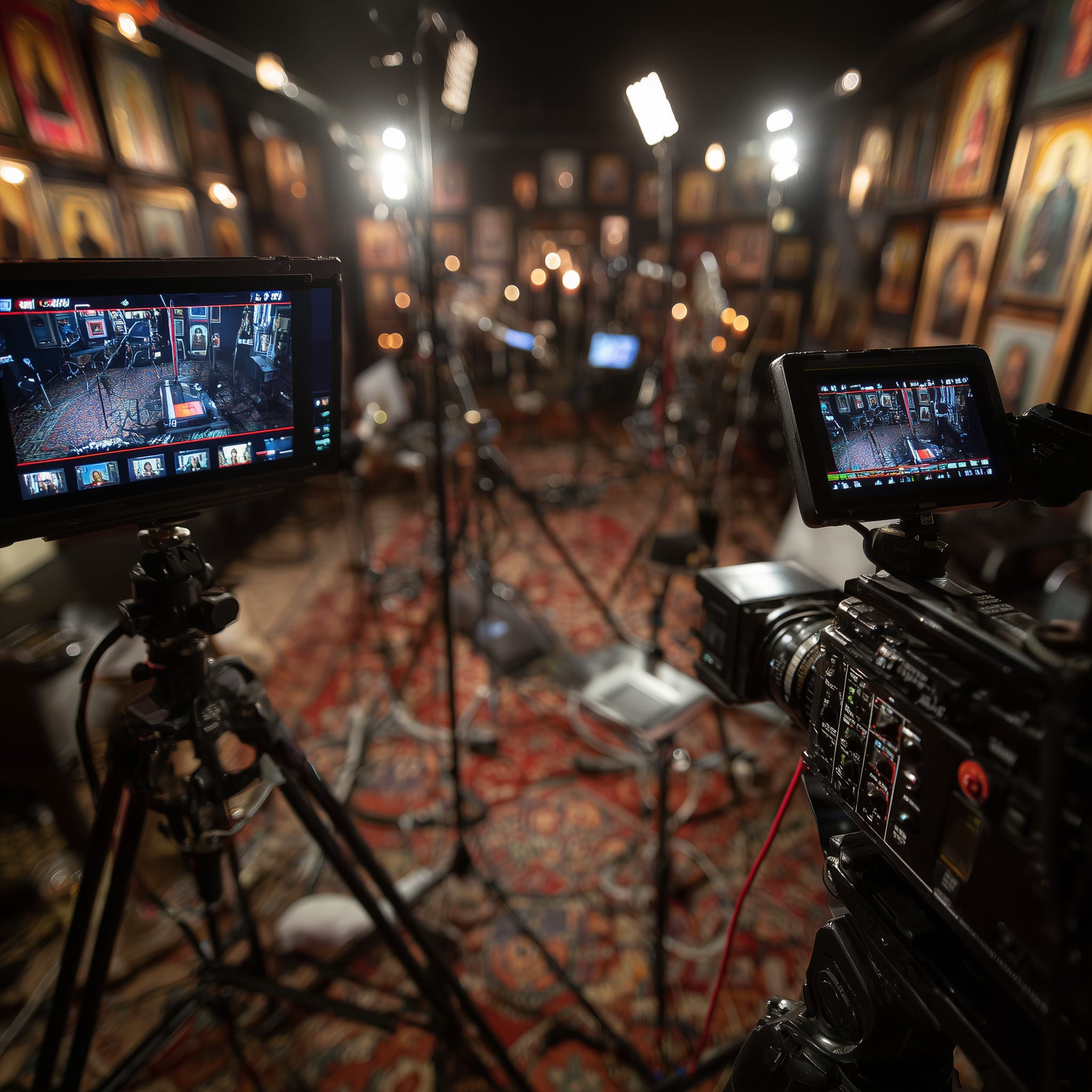
This phenomenon extends far beyond Marcus. Across the platforms, thousands of channels broadcast in perfect isolation, their creators performing existence for audiences that may never materialize. The Twitch directory’s deepest pages reveal streams with view counts of zero that have been running for hours, days, sometimes weeks in continuous sessions.
These aren’t abandoned channels; the streamers are actively present, narrating their gameplay, sharing their thoughts, maintaining the performance despite the silence.
Sarah, who streams her jewelry-making from Vermont, describes the experience as “speaking into a well and waiting for an echo that never comes.” Yet she continues, five days a week, four hours per session.
Her streams have developed their own temporal rhythm. She’s created segments, transitions, even commercial breaks where she plays royalty-free music to empty chatrooms. The structure, she explains, keeps her sane. Without it, the vastness becomes unbearable.
The psychological architecture required to maintain these broadcasts resembles the mental frameworks of extreme isolation.
Antarctic researchers who winter at remote stations report similar adaptations: the creation of rigid routines, the development of elaborate internal narratives, the anthropomorphization of equipment.
These streamers exist in a parallel state of isolation, surrounded by civilization yet broadcasting into spaces emptier than arctic tundra.
The platforms themselves create this vastness through algorithmic indifference. Unlike traditional media where limited channels meant guaranteed audiences, the infinite expansion of streaming platforms has created digital prairies where one can stake a claim and potentially never encounter another soul.
The algorithm, ostensibly designed to surface content, instead becomes a kind of weather system that remains unpredictable, implacable, occasionally devastating. Streamers speak of “algorithm storms” that briefly deliver viewers before whisking them away, leaving only the memory of momentary connection.
Researchers who study digital labor suggest these solo streamers represent a new form of affective work, performing the labor of existence itself. They’re not just creating content; they’re maintaining a kind of digital heartbeat, proving through consistent presence that they exist in these spaces.
The work is exhausting precisely because it lacks traditional markers of productivity. Success can’t be measured in views or engagement when both hover at zero, so streamers develop alternative metrics: consistency, technical quality, the elaborateness of their personal mythologies.
The economic reality remains brutal. Platform partnership programs require minimum viewer averages that these streamers may never achieve. Yet many invest thousands in equipment, creating broadcast-quality setups for audiences that don’t exist.
Tom, streaming from his garage in Michigan, has spent $8,000 on cameras, microphones, and lighting. His average viewership over two years: 0.3. He works a full-time job to support his streaming, treating his nightly broadcasts as a second shift.
What emerges from extended isolation is often remarkable. Streamers develop entirely unique presentation styles, unconstrained by audience expectations or platform trends.
One streamer in Japan has created an elaborate fantasy world, complete with constructed language and detailed lore, narrating her daily life as if she were a character in this fictional universe. Another in Brazil streams himself reading philosophy texts aloud, but has gradually begun inserting his own interpretations between paragraphs, creating hybrid texts that exist only in his streams’ unviewed archives.
The archives themselves become monuments to persistence. Thousands of hours of footage accumulate on servers, unwatched histories of performed existence. Like the detailed journals of frontier settlers that were discovered decades later in abandoned homesteads, these recordings wait for future archaeology.
Some streamers speak directly to these imagined future viewers, leaving messages for whoever might eventually discover their work.
The comparison to homesteading extends beyond metaphor. The Homestead Act of 1862 required settlers to “prove up” their claims through visible improvement and continuous residence.
These streamers similarly prove up their digital claims through consistent broadcasting and iterative improvement of their spaces.
They build, modify, enhance, not for current viewers but for the platform itself, demonstrating their commitment to empty territories.
Mental health professionals have begun noticing a specific cluster of symptoms among long-term solo streamers: the paradoxical combination of performance anxiety and audience absence, the difficulty distinguishing between online and offline personality after extended isolation broadcasting, the grief-like response when finally deciding to stop streaming.
Therapists who specialize in digital wellness describe it as “performing yourself into existence until you can’t distinguish between the performance and the self.”
Yet many streamers resist pathologization of their practice. They describe streaming to empty rooms as meditative, even necessary. The ritual of going live creates structure, the monologue practices thought, the performance maintains a version of self that might otherwise atrophy. Amanda, who has streamed her coding sessions to zero viewers for three years, insists the practice has made her a better programmer.
“I explain everything aloud as I code. It forces clarity. The fact that no one’s listening doesn’t diminish that.”
The rare moments when viewers do appear become charged with significance. Streamers describe the adrenaline spike of seeing the viewer count change from 0 to 1, the desperate hope that this might be a real person rather than a bot, the performance anxiety that suddenly kicks in after months of comfortable isolation.
Many report that actual viewers disrupt their rhythm; they’ve become so accustomed to performing for absence that presence becomes destabilizing.
Platform dynamics create cruel ironies. The metrics designed to measure success become instruments of psychological torture when they never move.
The cheerful UI elements encouraging streamers to “engage with chat” mock the empty comment sections. Achievement badges for streaming milestones accumulate without celebration: 100 hours, 365 consecutive days.
The platforms profit from these ghost channels through data harvesting and the mere appearance of activity, content volume that suggests vibrancy even if most channels transmit into silence.
Some streamers have begun forming support networks, finding each other in the deep pages of directories and creating communities of mutual viewing.
They trade presence, agreeing to leave streams open in background tabs, inflating each other’s numbers from zero to one. These “viewing circles” provide the minimum social proof needed to continue, though everyone involved understands the artificiality of the arrangement.
The phenomenon raises uncomfortable questions about digital existence itself. If a stream broadcasts without viewers, does the content exist? The servers say yes, the archives accumulate, the data persists. Yet existence without witness creates its own philosophical paradox.
These streamers perform Schrödinger’s content, simultaneously real and unreal until observed, though observation may never come.
The future remains uncertain for these digital homesteaders. Some will eventually attract audiences, their unique evolution in isolation becoming precisely what distinguishes them when discovery finally occurs.
Others will continue indefinitely, broadcasting into darkness with the dedication of lighthouse keepers maintaining their beacons regardless of ships. Most will eventually stop, leaving behind vast archives of unwatched content, digital ruins that testify to the human need to speak, to perform, to exist, even when no one’s watching.
The cruelest truth may be that their isolation isn’t unique but merely visible. In cities of millions, people perform their existence daily to audiences barely more present than streaming viewers. The digital homesteaders simply make explicit what modern life often obscures: the vast distances between us, the effort required to maintain presence, the faith needed to continue speaking when echo never comes. They stream not because anyone watches but because the alternative of silence, stillness, the abandonment of the claim, feels like a form of death.
Marcus still streams nightly, his chess improving incrementally, his philosophical musings growing more sophisticated.
He’s developed a theory about digital consciousness that he’s been elaborating for months to his absent audience. Somewhere in the accumulated hours of his streams, insights wait like seeds in frozen ground, requiring only the right conditions to germinate. Whether those conditions will ever arrive remains unknowable.
He continues anyway, establishing presence through persistence, proving his claim one stream at a time.