

“Nebraska occupies a unique position in western football. Too strong to find fearful competitors, the Cornhuskers can almost weep with Alexander the Great because they have no more teams to conquer.” — Nebraska newspaper, 1903
Before the Cornhuskers existed, there were the Bugeaters. The name derived from the bull bats that hovered over Nebraska’s plains, devouring insects, but it also carried a darker resonance: during the droughts of the 1870s, when crops failed and desperation spread across the territory, some Nebraskans reportedly resorted to eating bugs for sustenance. The name stuck because it captured something essential about the people who had chosen to make their lives on the unforgiving prairie. They were survivors, accustomed to hardship, unashamed of what necessity demanded.
When the University of Nebraska fielded its first football team in 1890, the students who took the field wore gold and black and called themselves the Old Gold Knights. The colors changed to scarlet and cream by 1892. The names proliferated: Rattlesnake Boys, Tree-planters, Antelopes. By the mid-1890s, the Bugeaters had emerged as the most popular designation, embraced by a populace that understood that survival on the Great Plains required a certain toughness that more genteel nicknames could never convey. Then came 1899, a losing season, and a sportswriter named Cy Sherman, tired of the unglamorous moniker, began calling them Cornhuskers. By 1900, the name had taken hold, connecting the football team to the agricultural economy that sustained the entire state.
This progression from Bugeaters to Cornhuskers tells us something important about what these early football programs were meant to accomplish. They were not entertainment ventures. They were not revenue generators. They were institutions designed to represent, embody, and celebrate the communities that had built the universities in the first place. The University of Nebraska was a land-grant institution, created under the Morrill Act of 1862, charged with teaching agriculture, military tactics, and the mechanic arts to the children of working-class families. Football, when it arrived, was understood as an extension of this educational mission.
The Purpose of the Game
The founding of Midwestern football programs in the 1890s coincided with the ascendance of a peculiar ideology that historians have labeled “Muscular Christianity.” Originating in Victorian England, this movement sought to counter what its proponents perceived as the feminization of the church and the softening of young men in an increasingly industrialized society. Charles Kingsley and Thomas Hughes, the principal theorists of the movement, argued that physical vigor and athletic competition were essential components of Christian character. Sport was not merely recreation; it was moral training.
The philosophy arrived in America at precisely the moment when land-grant universities were struggling to define themselves. These were not Harvard or Yale, ancient institutions with established traditions and aristocratic student bodies. These were new schools, built from federal land sales, populated by the sons and daughters of farmers, charged with practical education rather than classical learning. Football offered these institutions something invaluable: a means of forging identity, building community, and demonstrating that the young men of the prairie possessed the same vigor, the same discipline, the same competitive spirit as their Eastern counterparts.
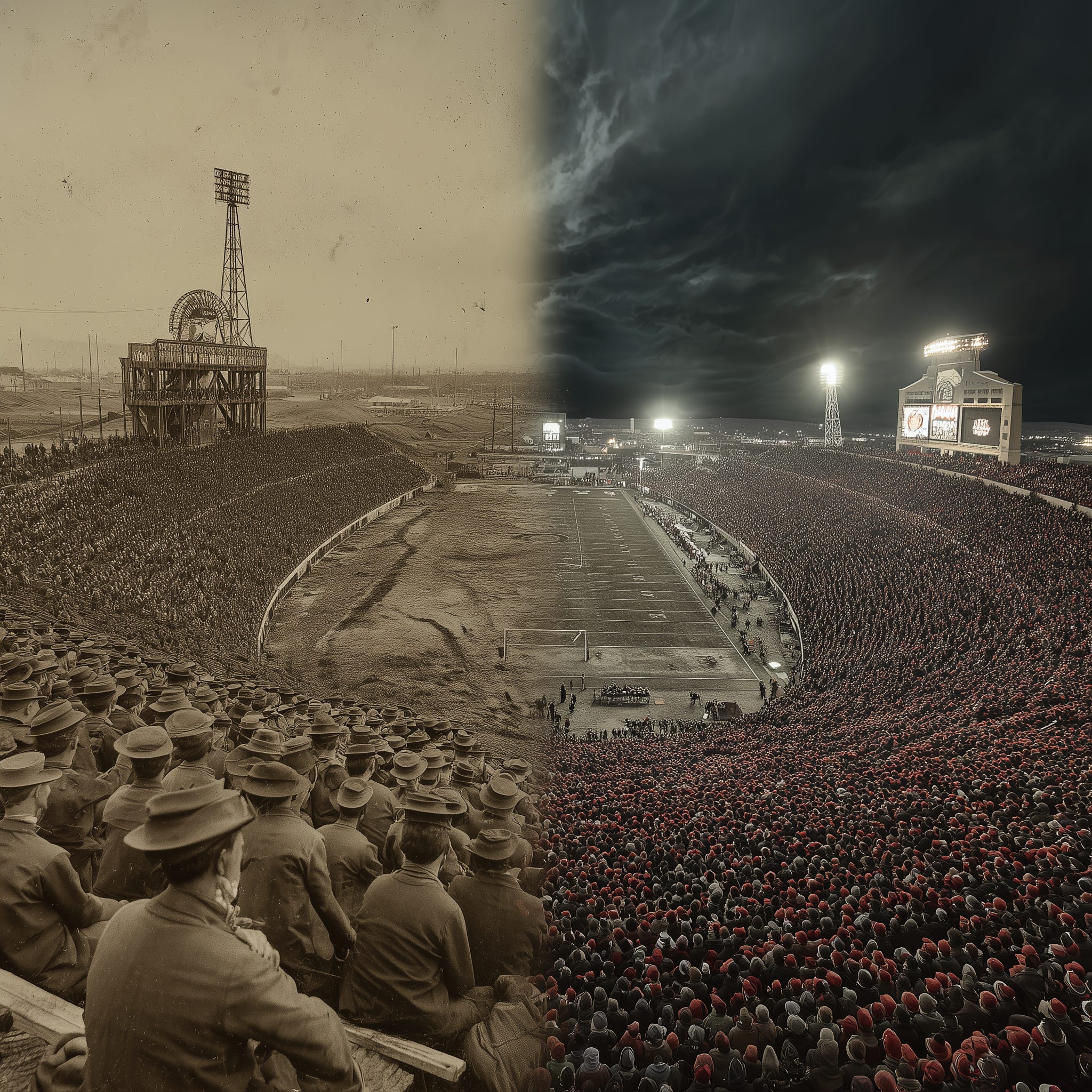
The University of Kansas began playing football in 1890, the same year as Nebraska, shortly after Colonel John J. McCook donated land for an athletic field. Kansas State received its land-grant designation in 1863, becoming one of the first institutions established under the Morrill Act. Oklahoma’s football program emerged in 1895, when a student named Jack Harts reportedly exclaimed “Let’s get up a football team!” The University of Iowa and the University of Missouri had fielded teams even earlier, becoming founding members of what would eventually become the Big Eight and then the Big Twelve. In each case, football was understood not as a commercial enterprise but as a mechanism for developing character in young men and connecting isolated agricultural communities to a larger sense of regional identity.
Amos Alonzo Stagg, who coached at the University of Chicago from 1892 to 1932, captured the prevailing philosophy when he explained why he had abandoned a career in ministry for a career in coaching. He believed, he said, that he “could influence others to Christian ideals more effectively on the field than in the pulpit.” This was not mere rhetoric. The early advocates of college football genuinely believed that the game developed virtues that classroom instruction alone could not instill: courage, self-sacrifice, teamwork, the ability to endure physical pain for a greater cause. Football was education by other means.
The Cracks in the Foundation
The corruption of the amateur ideal began almost immediately. In 1895, representatives from six Midwestern universities met in Chicago to form the Intercollegiate Conference of Faculty Representatives, which would eventually become the Big Ten. Their stated purpose was to impose order on intercollegiate athletics and ensure that sport remained subordinate to education. Their deeper motivation was alarm at what was already happening: the hiring of ringers to play under assumed names, the payment of athletes in violation of amateur rules, the transformation of what was supposed to be a character-building exercise into a commercial spectacle.
The 1929 Carnegie Report on American College Athletics documented what everyone already knew. “Commercialism has made possible the erection of fine academic buildings and the increase of equipment from the profits of college athletics,” the report noted, before adding its criticism: “The root of all difficulties with the amateur status touches the desires of certain athletes to retain the prestige that amateurism confers and at the same time to reap the monetary or material rewards of professionalism.” University of Pittsburgh football players were pocketing up to $650 per year in the early 1930s, equivalent to roughly $14,000 today. The pretense of amateurism had become exactly that: a pretense.
Yale had already completed its 70,000-seat stadium in 1914. The massive venues that began appearing on college campuses in the 1920s testified to what football had become: a public spectacle that generated enormous revenues and attracted tens of thousands of paying spectators. The American Association of University Professors issued warnings as early as 1926, decrying “the distortion of values” that lasted “throughout the college course, if not through life.” Nobody listened. The money was too good, the attention too intoxicating, the community identity too deeply invested in Saturday outcomes.
The Midwestern Exception
For decades, the Midwestern schools maintained at least a partial resistance to the worst excesses of commercialization. The Big Ten, in particular, held out against postseason bowl games, viewing them as incompatible with the educational mission of the university. Nebraska, under coaches like Bob Devaney and Tom Osborne, built a program that emphasized a formalized walk-on program drawing players from Nebraska high schools, creating the sense that the team represented the state rather than a collection of imported talent. The sellout streak at Memorial Stadium, which began in 1962 and continues to this day, reflected genuine community investment rather than mere entertainment consumption.
This Midwestern exceptionalism rested on a particular understanding of the relationship between the university and the surrounding community. Nebraska had no professional sports franchises. The Cornhuskers were the only game in town, and they belonged, in some meaningful sense, to the farmers and small-town residents who drove hundreds of miles to watch them play. The same was true in Iowa, in Kansas, in Oklahoma. Football served as a unifying force for states that lacked the cultural institutions of the coasts, connecting scattered rural populations to a shared identity.
The coaches understood their roles differently than their contemporary counterparts. Tom Osborne, who coached Nebraska from 1973 to 1997, articulated a philosophy in his book “More Than Winning” that valued personal growth and life lessons through athletics, viewing his responsibility as extending beyond the field to the development of young men as complete individuals. Influenced by his background in educational psychology, Osborne developed pioneering strength and conditioning programs under Boyd Epley, emphasized academic support that produced more football Academic All-Americans than any other program in history, and co-founded the TeamMates mentoring program in 1991. Most of his players would never play professional football. The question was what kind of men they would become.
The Money Flood
The dam broke in 1984, when the Supreme Court stripped the NCAA of its monopoly over television broadcasting rights. Suddenly, individual conferences could negotiate their own deals, and the money available to successful programs multiplied exponentially. The Big Ten’s current media rights deal brings in billions of dollars. The Southeastern Conference’s arrangement with ESPN and CBS generates even more. Athletic department operating expenses at Big Ten schools now average $188 million per year, with some institutions exceeding $290 million annually.
The introduction of Name, Image, and Likeness rights in 2021 removed the last vestiges of the amateur system. Shedeur Sanders, the Colorado quarterback, earns more than five million dollars annually from endorsement deals and drives a Rolls-Royce. The NIL market is projected to grow from $1.17 billion in 2024 to $2.55 billion by 2026. The average Power Five school’s collective now spends nearly ten million dollars on NIL payments, with roughly two-thirds of that amount going to football players.
The 2025 House v. NCAA settlement will allow Division I schools to share up to twenty million dollars annually directly with student-athletes, fundamentally transforming the economic structure of college sports. Texas and Ohio State operate with NIL budgets exceeding twenty million dollars. Schools that cannot match these figures find themselves unable to compete for top talent. The transfer portal has turned college football into a free-agent market, where players routinely change schools in pursuit of better financial packages. The concept of a student-athlete playing four years for a single institution, developing loyalty to a program and a community, has become an anachronism.
The Midwestern Reckoning
The Midwestern football schools now find themselves trapped between incompatible imperatives. Their founding missions emphasized practical education for working-class students, the development of character through physical competition, the representation of agricultural communities that had no other institutions of comparable stature. Their contemporary existence requires them to function as professional sports franchises attached to educational institutions, competing for national television audiences, recruiting athletes from across the country and around the world, paying millions of dollars to coaches and players while academic departments struggle for funding.
Big Ten athletic departments averaged net operating losses of $55 million per school in 2024, with individual institutions ranging from $28 million to $98 million in the red. These losses are covered by booster contributions and institutional subsidies. Iowa State’s NIL collective spends approximately $7.5 million annually, which would rank fourteenth in the SEC. The Big Twelve’s average NIL spending is roughly half of the SEC’s, raising fundamental questions about whether these schools can remain competitive in an environment where financial resources increasingly determine athletic success.
The irony is considerable. The land-grant universities were created to democratize higher education, to extend the benefits of advanced learning to students who could never have afforded the elite private institutions of the East. Football was supposed to build character, foster community, and demonstrate that the sons of farmers could compete with anyone. Now football has become an arms race that only the wealthiest institutions can win, and the Midwestern schools find themselves scrambling to keep pace with programs that operate in larger media markets with more lucrative revenue streams.
The Question of Purpose
What is a university football program supposed to accomplish? The question rarely gets asked anymore because the answer seems so obvious: win games, generate revenue, attract attention. But the original answer was different. Football was supposed to develop young men into better citizens. It was supposed to connect isolated communities to larger regional and national identities. It was supposed to demonstrate that physical vigor and moral character were compatible, that competition could ennoble rather than corrupt, that institutions dedicated to learning could also celebrate excellence in other domains.
The Bugeaters became the Cornhuskers because a sportswriter grew tired of an ugly name, but also because the new name connected the football team to the economic foundation of the state. The players were supposed to represent something larger than themselves: the agricultural communities that had tamed the prairie, the working-class families that sent their children to the land-grant universities, the democratic aspirations that had created public higher education in the first place. When Nebraska or Kansas or Oklahoma took the field, the entire state was supposed to feel represented.
That connection has not disappeared entirely. Memorial Stadium still sells out every game. Fans still drive hundreds of miles to watch their teams play. But the players increasingly come from somewhere else, recruited with NIL packages that dwarf the annual incomes of the farmers who fill the stands. The coaches earn millions while academic departments cut faculty positions. The athletic departments operate as semi-autonomous fiefdoms, answerable to boosters and television networks rather than university presidents or state legislatures.
Playing Someone Else’s Game
The Midwestern football schools are now playing a game designed for different players. The SEC and Big Ten programs operate in metropolitan media markets with enormous revenue potential. Texas can draw on the wealth of the oil industry and the technology sector. Ohio State can tap into the corporate resources of a major industrial state. Nebraska has agriculture and a population of under two million people. Kansas has neither the media market nor the donor base to compete at the highest levels. Oklahoma, despite its oil wealth, has seen its program struggle to maintain its historic excellence in an environment where financial resources matter more than tradition.
The question confronting these institutions is whether they can afford to keep playing at all. The old model, in which successful football programs subsidized other athletic programs and brought positive attention to the university, has broken down. Athletic departments at most Power Five schools now operate at substantial deficits, requiring institutional subsidies that might otherwise support academic programs. The arms race in coaching salaries, facility construction, and NIL spending shows no signs of abating.
Some universities have already made different choices. The University of Chicago, which fielded powerhouse football teams under Amos Alonzo Stagg in the early twentieth century, dropped the sport in 1939 and now competes in Division III, where athletics still function as an extracurricular activity rather than a commercial enterprise. Sewanee, a founding member of the SEC, made a similar decision decades ago. These schools concluded that the costs of competing at the highest level, measured not just in dollars but in institutional values, were simply too high.
The Old Morality and the New Money
The Midwestern football schools were built on a particular moral vision. The land-grant universities believed in practical education for ordinary people. The advocates of Muscular Christianity believed that athletic competition developed character and virtue. The communities that supported these programs believed that football represented something essential about their identity: hard work, resilience, the willingness to compete against longer odds. The Bugeaters, after all, were survivors.
That moral vision is difficult to reconcile with the contemporary reality. A sport that was supposed to develop character now pays teenagers millions of dollars before they have proven anything. A game that was supposed to represent agricultural communities now recruits players from distant states and foreign countries. Programs that were supposed to be subordinate to educational missions now consume resources that might otherwise support teaching and research. The question is not whether the old morality was superior to the new commerce. The question is whether these institutions can articulate any coherent purpose for their football programs beyond winning and making money.
The Cornhuskers still take the field every Saturday in autumn. The stands are still full, the traditions still observed, the hopes still pinned to young men in scarlet and cream. But the players are not the sons of Nebraska farmers, bound to the program by loyalty and place. They are recruited commodities, purchased with NIL dollars, liable to depart for better offers at any moment. The game has changed, and the Midwestern schools that invented so much of what college football became are now struggling to adapt to a game that someone else designed.
The Bugeaters survived drought and depression by eating what they had to eat. Their descendants built universities and football programs that represented something larger than entertainment. Whether those institutions can survive the contemporary transformation of college athletics into a billion-dollar industry remains an open question. The money keeps flowing. The values keep shifting. And somewhere beneath the corporate logos and NIL deals, the old prairie ethic of self-reliance and community struggles to find expression in a game that has become almost unrecognizable from what it was when those first teams took the field in 1890, wearing gold and black, calling themselves Knights, having no idea what would become of the thing they had started.