

The Homestead Act of 1862 was a rural policy. President Lincoln signed it during the Civil War to move continental land out of federal hands and into the hands of settlers willing to live on it. The mechanism was precise: file a claim on 160 acres of public land, live on the parcel for five years, improve it, and receive title. Between 1862 and 1976, when the Federal Land Policy and Management Act repealed the homesteading provisions in the contiguous states, the United States distributed approximately 270 million acres this way. A final Alaskan patent was issued to Kenneth Deardorff in 1988. The registered claim is one of the few legal instruments that shaped the physical geography of the Great Plains as thoroughly as the plow did.
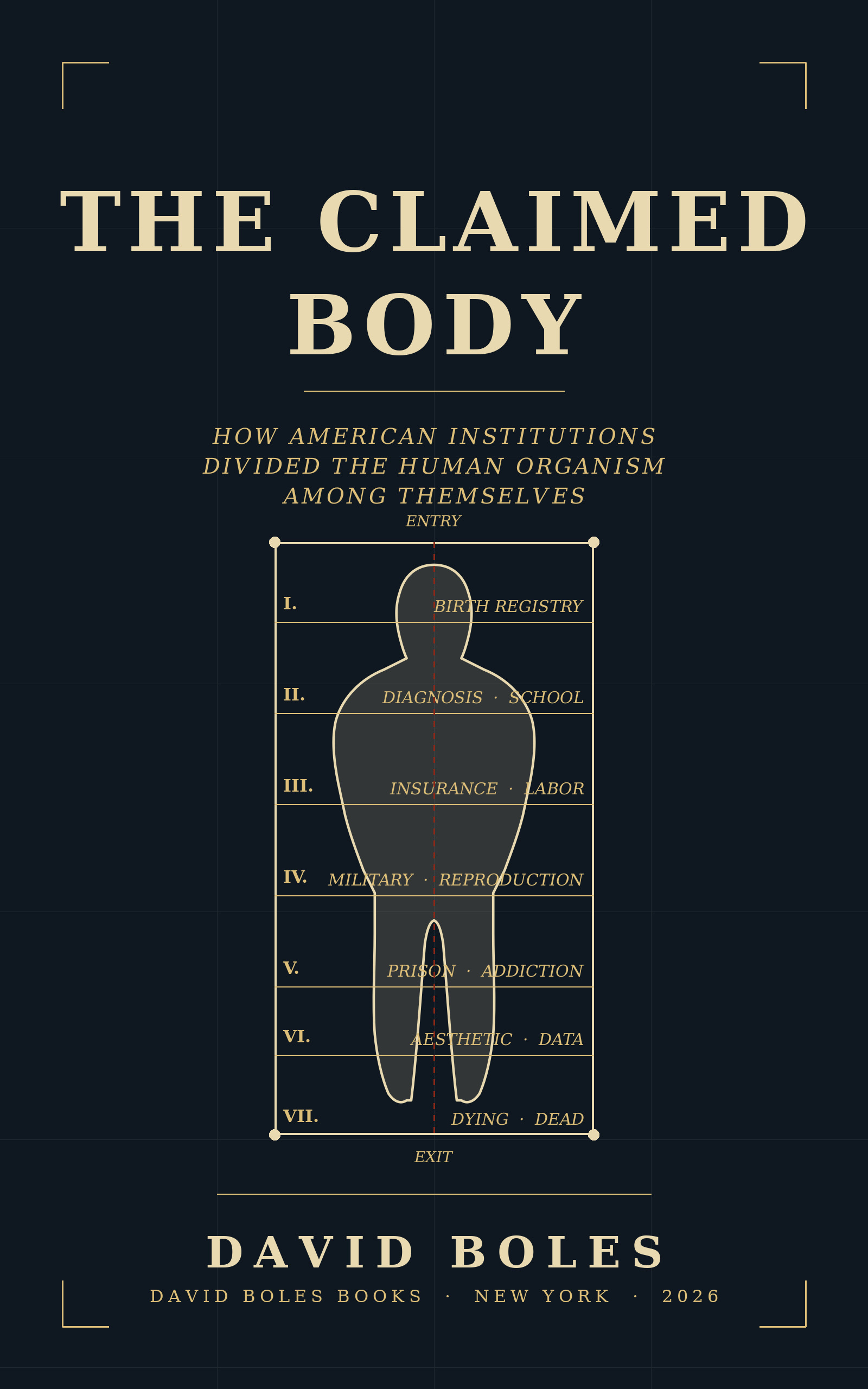
My new book, The Claimed Body: How American Institutions Divided the Human Organism Among Themselves, argues that the Homestead Act’s registered-claim logic did not retire in 1976. It migrated. It now operates on the American body instead of on American land. Institutions file claims on portions of the body the way settlers once filed claims on parcels of ground. A hospital claims your birth. A school claims your developmental measurements. An insurer claims your diagnostic history. An employer claims your labor capacity and your drug screens. The state claims your reproductive eligibility and your military eligibility. At the other end of life, a dying registry claims the moment of your cessation and a funeral corporation claims the disposal of your remains. Every claim has its paperwork, its jurisdiction, its enforcement mechanism, and its procedural history. No single institution claims the body in its entirety. Many institutions claim portions of it, at specific moments, under specific authorities.
This is the book’s general argument. Prairie Voice readers will want to know what the general argument does when it lands on the rural body specifically, because the rural body turns out to be the case where the argument bites hardest.
Consider the architecture. An institutional claim on the body requires two things to function: a filing mechanism that registers the claim, and an adjudicating forum where the claim can be contested. The Homestead Act had both. A settler filed at the General Land Office. A settler whose claim was challenged could contest the challenge in federal district court, with an appellate pathway that ran, at least in theory, to the United States Supreme Court. The institutional claim and the institutional forum came together. That coupling is what distinguished the homestead claim from an act of confiscation.
The rural body in 2026 retains the filing mechanism but has lost most of the adjudicating forum. A rural patient’s medical record is filed, coded, billed, and transmitted to insurers, actuaries, credit bureaus, and pharmacy benefit managers on the same infrastructure a suburban patient’s record travels through. The claim goes up. The data goes out. What the rural patient has lost is the forum. Rural hospitals have closed at a documented rate across the past fifteen years. According to the Chartis Center for Rural Health, drawing on data maintained by the Cecil G. Sheps Center at the University of North Carolina, 182 rural hospitals in the United States have closed or converted away from inpatient care since 2010. Forty-six percent of surviving rural hospitals operate with a negative margin. Pharmacies serving those same rural communities have closed in parallel. School districts consolidate, which collapses the local authority over the pediatric claims a district files on its students. County courts run on skeleton dockets. A rural body filing a grievance against an insurer’s denial, an employer’s drug screen result, or a pharmacy benefit manager’s coverage decision may find that the nearest attorney who takes such cases is three counties away and booked six months out.
The claim tightens, and the forum recedes. A rural body holds the filing paperwork without holding the procedural ground on which to contest it. That is a confiscation in substance, whatever it is called in form.
This is not an abstract point. Take the FICO score, which I analyze in chapter five of the book. A score originally designed in the 1950s to predict whether a borrower would repay a loan has, across the past three decades, migrated into apartment screening, employment background checks, cellular contracts, utility deposits, and, most consequentially for rural readers, auto and homeowner’s insurance pricing. In most American states, with the exception of California, Hawaii, Massachusetts, and Michigan, a driver’s car insurance premium is calculated in part using a credit-based insurance score. Rural drivers tend to carry more miles, more vehicles, and more weather exposure than urban drivers. A rural driver with a thin credit file, as many agricultural households carry, pays a premium structured as if the driver were a higher risk than the driving itself warrants. The institutional claim has filed on the rural body’s creditworthiness and priced the rural body’s insurance accordingly, without any forum in which the rural body can effectively challenge the pricing logic or the score’s migration out of its original domain.
That pattern repeats. Clinicians built the DSM to communicate about mental distress, and it now codes rural disability determinations and custody evaluations. Congress created the Social Security number to track a specific federal benefit, and it now identifies rural bodies across every major institutional system. Pediatricians developed the percentile chart to catch failure-to-thrive, and it now sorts rural children into school-readiness tracks with no rural pediatrician available to interpret the chart for the rural parent. Each instrument escaped its original purpose, migrated across institutional domains, and arrived at a rural body without bringing a rural forum with it.
What the Homestead Act understood, and what the contemporary institutional apparatus does not, is that a claim is only legitimate when the person claimed upon can contest the claim in a forum that has jurisdiction and capacity. Otherwise the claim becomes, as a matter of structural condition, an enclosure. The Homestead Act distributed 270 million acres of continental North America on the principle that claims require forums. A rural body in 2026 encounters institutional claims without forums every day.
The Claimed Body does not address rural America as its exclusive subject. The book takes the structural condition of the American body under institutional pressure as its general argument. What happens, though, is that the argument sharpens when the body in question is a rural one, because rural communities have watched their institutional forums thin out in real time across the past two decades while the claims on rural bodies tightened. Readers who work with rural bodies every day, whether as clinicians, attorneys, veterinarians, teachers, clergy, or extension agents, will recognize the structural pattern the book names.
On Amazon, the book is available now in Kindle and paperback. BolesBooks.com carries it for direct ordering and for free online reading. Fifteen chapters of institutional claim-tracking, from birth registries through incarceration through data brokerage through the procedures of dying and death.
The homestead did not end. It turned inward.
David Boles is the author of twenty-plus books on American institutional life, including Carceral Nation and The Human Universal Beautiful. Prairie Voice runs his continuing reports from the ground of rural American experience.