

A new book of stories set in this country begins in Perkins County, and it begins the way the county’s year begins: on a scale.
Every harvest the trucks line up at the Grant co-op before the yard lights quit, loaded with the district’s milo, and every truck crosses the same steel plate twice, once full and once empty, because a crop is only money after the scale says what it is. The scale man sits over the receiving pit in a glass shack and gives every dial time to settle. Twenty-one years he has sat that stool, in the book’s telling, and farmers who were boys when he started send their own sons over his scale now. Men frame his tickets. At the Legion on Central Avenue, an argument over what a steer taped in ‘88 ends when somebody says his ticket says different, and the ticket does say different, and that is the end of it. The state man comes every June with his iron weights and writes his certificate and goes away with nothing to say. Twenty-one certificates hang in a plain frame over the counter.
What the state man weighs is the platform. What the platform weighs is the county. And inside the dial head on that platform, the book tells us, there is a sleeve of steel the length of a little finger, turned on the machine shed’s lathe in the February of 1974, when the co-op was dying and the margin could not carry the debt. A scale is two weighings and a subtraction, and the county watches the big one. The sleeve sits in the path of the small one. Every load since has weighed true, and every empty truck has weighed heavy, two percent heavy, and the difference came off the farmer’s ticket and stayed in the house.
The co-op lived. The gain folded into shrink and dockage, the ordinary mysteries of grain, and because a co-op belongs to its members, part of the money went back out every March as patronage checks, and the members cashed them and praised the margin and praised the scale and the man who kept it. He robbed the membership and handed the money back to them and they loved him for the weight of the envelope. In ‘81, when the rates ran to twenty percent and his own note came due, the board voted the scale man a bonus in the hard year, and the bonus saved his place, and no one at that table knew whose money it was.
That is the engine under “The True Weight,” the first story in David Boles’s new book, and against that engine the story sets one October week in 1994. Lorna Stelk comes through the line twice a day in Verle’s old GMC, her hat pulled down and his gloves on the wheel, and she has said at the church and at the cafe that this is her last year with a crop, and no one has asked her reasons. Her last load comes in at dusk on the tenth of October. The association’s schedule wants 19,700 pounds off it to close the note. The ticket prints 19,360. That load came in three hundred forty pounds short of the line the association drew, and three hundred forty pounds is, to the pound, the sleeve’s creep on that truck. The machine took the widow’s margin exact.
What the scale man does about it is the story, and it is done with paper. He finds a keying slip in the office’s settlement sheet, four hundred pounds carried wrong in the house’s favor, and he writes a correction certificate in the square small hand the tickets are written in. The arithmetic closes the schedule with sixty pounds to spare. The risk is the audit: an auditor starts with the amendment and works outward, and outward from that account is a truck in a widow’s shed that would not survive one honest weighing, and behind it twenty years of the district’s tickets. He signs it anyway. By eleven the next day the word comes back that the widow wintered, on a catch by Ott Rehmer, who never missed, and two or three drivers say so at the window while he signs their tickets.
The book does not absolve him and it does not hang him. It ends its first story in the cold, after the last truck, when he banks the stove and steps out to the platform alone and lays his hand flat on the steel plate and leans his weight into the arm. Through the glass he watches the needle climb past forty and past sixty, and it settles at ninety and holds. The needle is honest. The lie never lived where loads were weighed. A hand is a load, and no one anywhere is watching the scale man weigh himself on the machine he made.
People who keep books in this county will read the story the way a ledger reads: exact. Its figures reconcile, its calendars hold, and the equipment is the equipment we know. Even the sentence the scale man says once aloud, to a crew cook out of Oklahoma who will be gone at daylight, is accounted for: everything weighs more than it says. She carries it out of the county and off the high plains, and it comes back under oath on a Gulf dock two stories later, because that is how this book is built. Each story lends a person to the next, quietly, and the sentence is the first thing lent.
The rest of the county’s harvest furniture is in there too, the way we would want it kept: the triplicate tickets, white for the farmer, yellow for the office, pink for the house; the auger men in the dust; the siding with its string of empty cars; the crew cook’s pail going back lighter than it came down. And the county we live in is the county in the book: Grant, Madrid, Elsie, Imperial, the Venango road, the table above the Republican. The story that starts here comes home here, thirty-two years later, on one September evening in 2026, at a card table on the east edge of Grant, in the book’s title story.
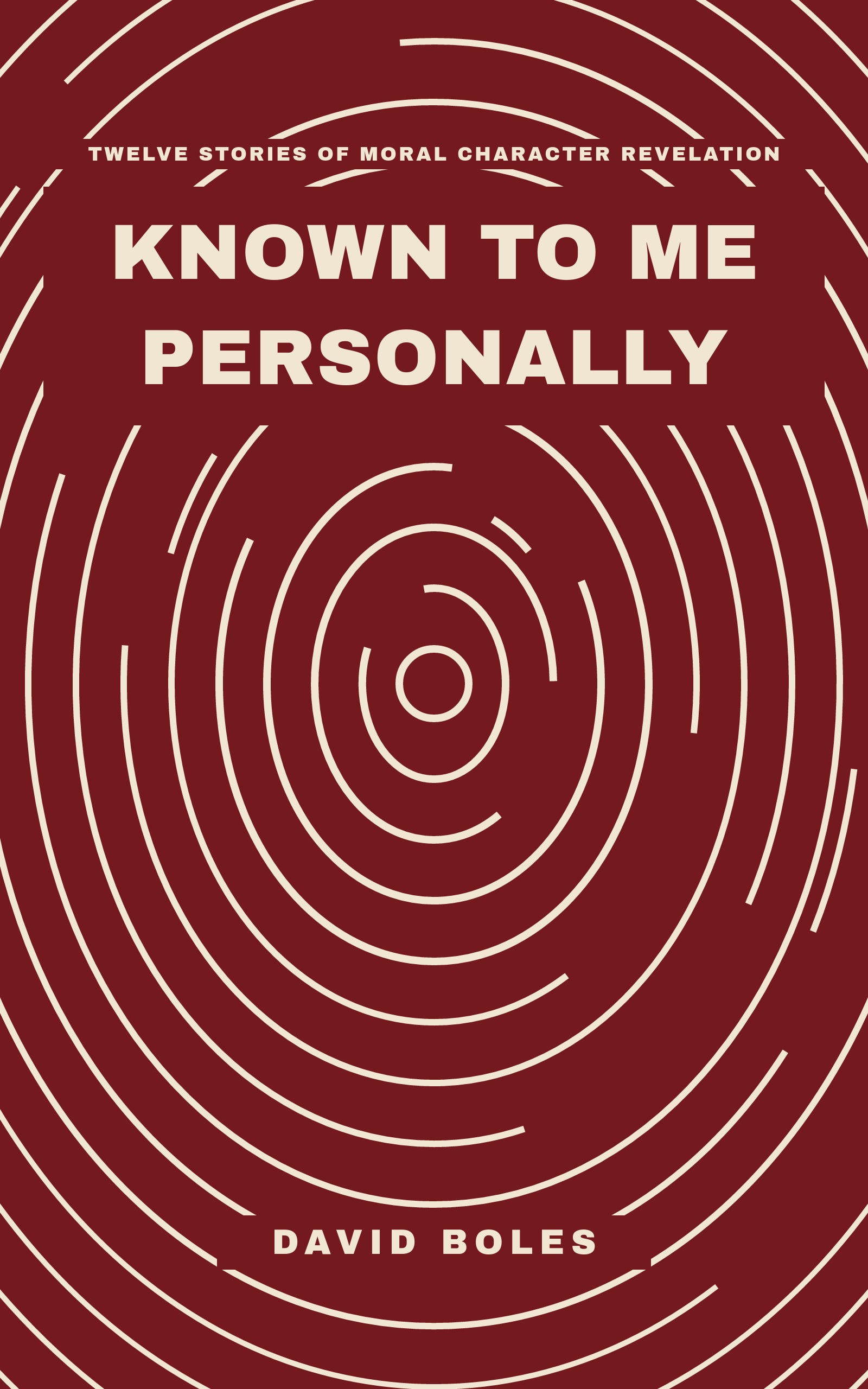
If you want the rest of it, Known to Me Personally: Twelve Stories of Moral Character Revelation is out now from David Boles Books, in ebook, paperback, and audio, wherever books are sold. The first story, this one, is free to read at bolesbooks.com.