

The cornfields outside Council Bluffs, Iowa, grow in neat rows until they don’t. Where the agricultural geometry breaks, a different kind of harvest begins: thousands of wind turbines across Iowa converting prairie wind into electricity that flows through buried cables to windowless buildings the size of shopping malls.
Google operates a massive campus here, Facebook has facilities in Altoona, Microsoft builds in West Des Moines. The buildings squat on former farmland like enormous beetles, their cooling systems exhaling heat that makes the adjacent fields shimmer even in winter. This is where your searches go to live, where your photos get processed, where the infrastructure of modern consciousness physically exists in buildings designed to be invisible.
The scale defies rural comprehension. Google’s Council Bluffs campus, begun in 2007, has grown through continuous expansion, with the company announcing $424 million in new investment in 2023.
They chose Iowa for the wind. MidAmerican Energy, the state’s largest utility, generates the majority of its Iowa electricity from wind, among the highest percentages in the nation. The farmers who lease land for turbines receive thousands of dollars per turbine annually, a more reliable income than corn or soybeans have provided in decades. They joke about their new crop rotation: corn, soybeans, and server farms.
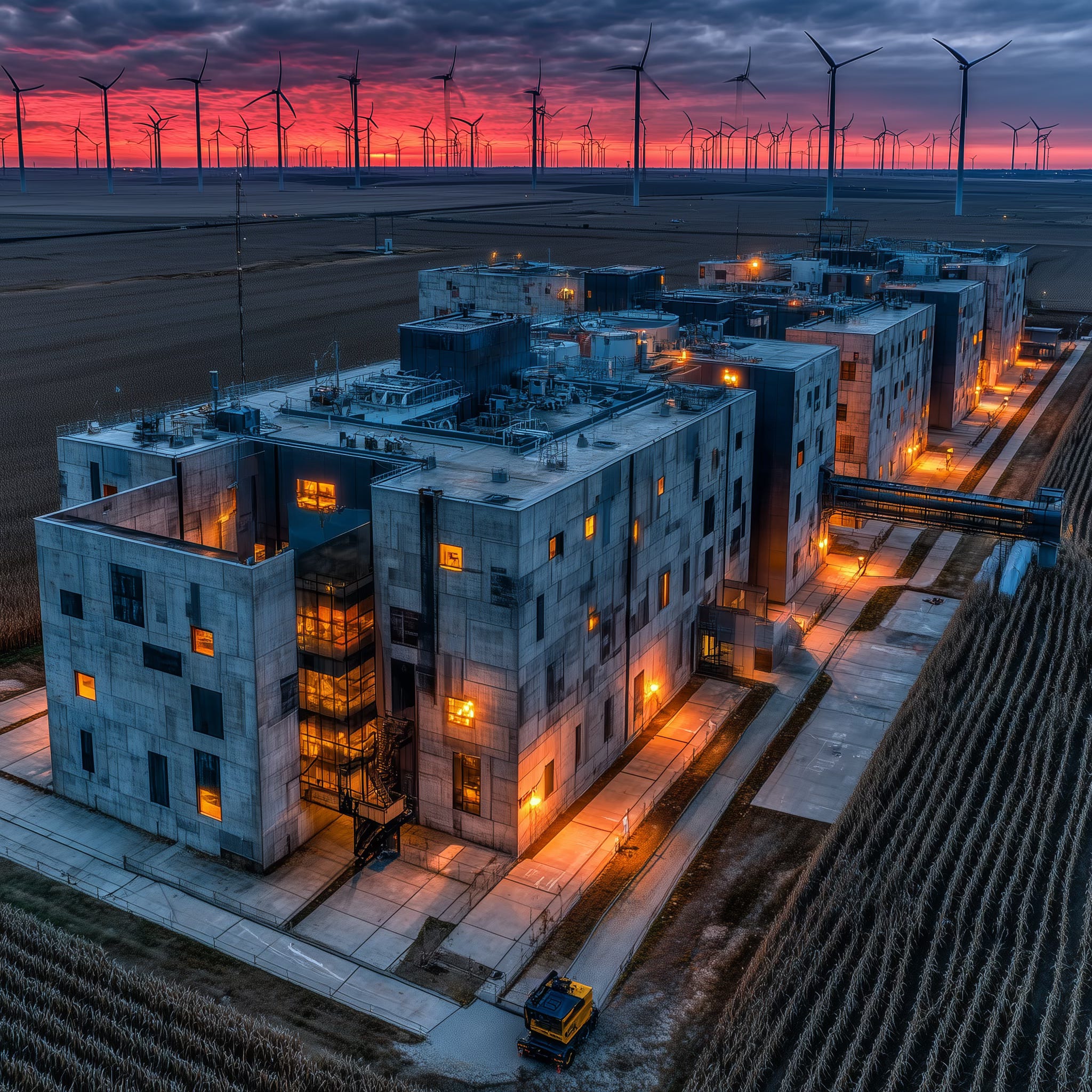
Inside these facilities, which employ surprisingly few people relative to their size, the real population consists of servers stacked in rows that stretch longer than city blocks. The cooling requirements are staggering.
During drought years, local communities have raised concerns about water usage as data centers consume millions of gallons while residents face watering restrictions. The tension between industrial water needs and agricultural irrigation creates a new kind of resource competition on the prairie.
Facebook’s first Iowa data center in Altoona, begun in 2013, transformed a town of roughly 15,000. During construction, workers from across the country descended on the area. Local restaurants added shifts. Hotels stayed booked.
Then construction ended, and the town returned to its previous quiet, except now a facility worth hundreds of millions sits at its edge, employing hundreds to maintain machines that never sleep.
The marginal farmland near the Des Moines River floodplain now hosts infrastructure worth more than all the corn that land could grow in centuries.
The ironies accumulate like snow against fence posts. Rural communities that fought for decades to get basic broadband now host the backbone of global internet infrastructure. Schools that struggled to afford computers sit within miles of buildings containing more processing power than most universities.
The data centers bring tax revenue but few jobs relative to their valuation. A single John Deere factory employs more people than several data centers combined, despite the vast difference in capital investment.
Workers at these facilities sign strict non disclosure agreements, but those who will talk describe a particular kind of isolation. They monitor server health through screens, walking the humming corridors only when something fails.
The sound inside resembles an enormous hive, a white noise so complete it becomes a kind of silence. Technicians wear noise canceling headphones not for the volume but for the constancy. Eight hour shifts pass without human conversation, just the communion between human and machine, checking temperatures, replacing failed drives, ensuring the flow of data never stops.
The environmental equations grow more complex each year.
These companies claim carbon neutrality through renewable energy purchases, and Iowa’s wind farms do generate clean electricity. But the centers’ massive energy consumption still strains the grid, and backup generators burning diesel sit ready for when the wind doesn’t blow.
The heat exhaled by cooling systems creates micro climates. Farmers report their fields near data centers staying snow free in rings around the facilities, the ground warmer, the growing season slightly extended, though whether this helps or harms remains unclear.
Nebraska follows Iowa’s model, courting data centers with tax incentives.
Google announced plans for facilities near Omaha, where the public power district has been increasing its renewable energy portfolio. Facebook operates in Papillion, Nebraska, where hundreds of acres of solar panels create a strange new prairie where native birds nest between panels that track the sun like mechanical sunflowers.
These facilities reshape rural economies in ways still being calculated. Counties that struggled to fund basic services now receive significant tax revenue. Construction workers travel a circuit following new data center builds, temporary boom towns emerging then dissolving.
Local community colleges create programs for data center technicians, training farm kids to maintain servers instead of tractors. The young people who might have left for cities now have a reason to stay, though the work offers none of the community that farming once provided, no shared harvest, no neighbor helping neighbor, just isolated shifts maintaining machines whose purposes remain abstract.
The data centers also create a new kind of rural vulnerability. When facilities go offline during extreme weather, services crash globally for companies whose users have never heard of these Iowa towns.
The physical infrastructure of digital life concentrates in these rural locations precisely because land is cheap and populations are sparse, but this geographic distribution makes the system both resilient and fragile.
A tornado in Iowa can disrupt services for millions. A sustained drought could force centers offline as water becomes too scarce for cooling.
What grows now in these digital prairies isn’t measurable by bushels per acre but by data processed, not by rainfall but by latency measured in milliseconds.
The farmers who once read the sky for weather now have wind speed apps on their phones, tracking whether the turbines on their land are generating enough electricity to power the data centers that process the weather apps themselves.
This recursive loop, where the prairie wind powers the servers that predict the prairie wind, captures something essential about how rural America has been colonized by the digital economy without most of its residents fully understanding what that means.
At night, the data centers glow faintly through their few windows, creating new constellations on the horizon.
The red lights atop wind turbines blink in synchronization, a rhythm visible for miles across flat land. Between them, actual stars still shine through the light pollution, though fewer each year as facilities expand.
The prairie that once seemed infinite now hosts the infrastructure of infinite information, two kinds of endlessness meeting in fields where corn still grows right up to the fence lines of buildings that process billions of human interactions every second.
The transformation continues. Amazon scouts sites across both states. Apple considers Midwest facilities. The prairie states compete to offer the best combination of renewable energy, tax incentives, and that increasingly valuable resource: emptiness itself, space where massive facilities can exist without bothering anyone except the farmers who cash the lease checks and wonder what exactly they’re harvesting now.
The data center prairie represents neither progress nor decline but something more complex: a new form of colonial economy where the extractive resource is wind and isolation rather than minerals or crops.
The prairie that once fed the nation’s body now feeds its digital nervous system, processing the endless appetite for data with the same resigned efficiency it once processed grain.
The land remains productive, just productive of something its residents can neither see nor fully comprehend, their home transformed into a crucial organ of systems that exist everywhere and nowhere at once.